
Base post-mortem reveals sequencer bug behind back-to-back outages
Base post-mortem reveals sequencer bug caused two outages halting block production for nearly two hours on Coinbase's Layer 2 in June 2026.
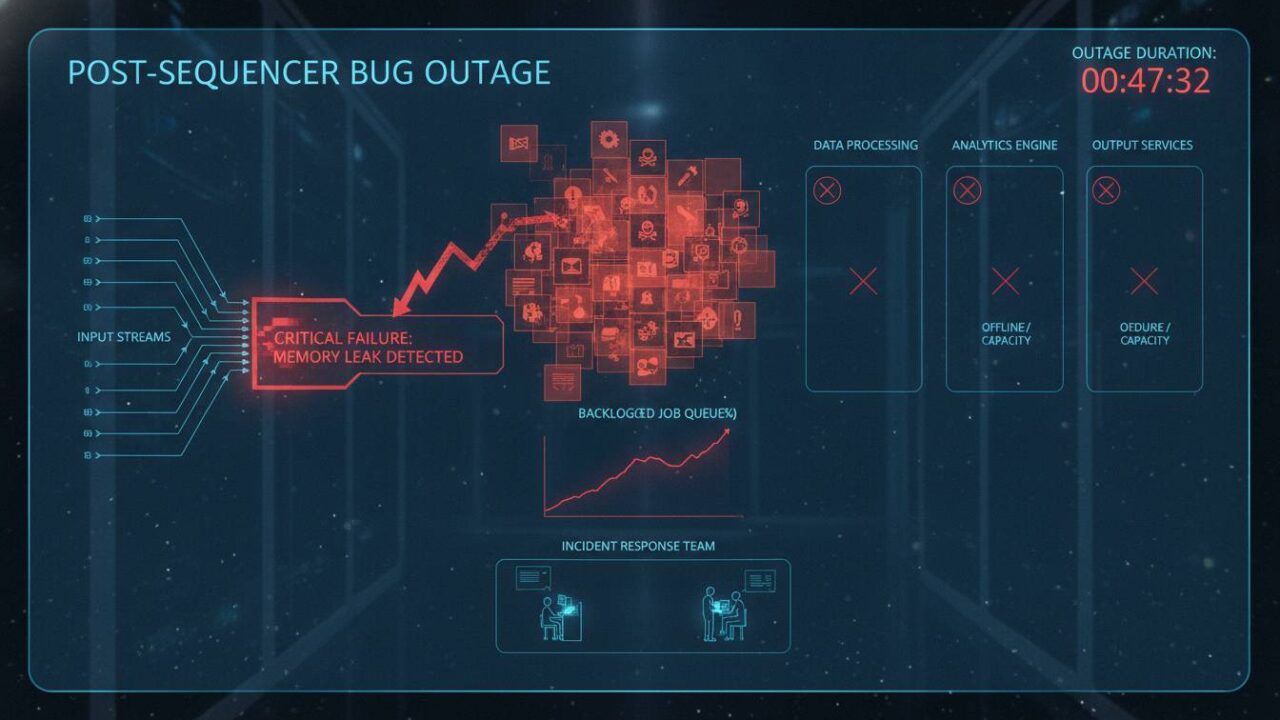
Base, Coinbase‘s Layer 2 network, halted block production twice last week, according to Gncrypto’s report. The outages lasted 116 minutes and 20 minutes, triggered by a sequencer bug. The first stoppage occurred on June 25 near block height 47,806,542, while the second happened the following day, June 26.
At approximately 16:03 UTC on June 25, Base’s sequencer encountered a consensus failure due to an invalid block sequence, Crypto Briefing reported. This issue froze block production for nearly two hours, with sequencing resuming around 17:51 UTC. Coincu data highlighted a liveness anomaly lasting 78 minutes during this downtime. The second disruption started at 15:34 UTC the next day, lasting about 20 minutes before block production recovered at 15:54 UTC. Both outages originated from problems with the centralized sequencer responsible for ordering transactions and creating blocks for Base. When this sequencer fails or sequences an invalid block, the entire network halts due to the absence of a backup sequencer, revealing a critical vulnerability.
The Beryl upgrade and B20 token standard
Crypto Briefing states the Beryl hard fork introduced the B20 native token standard on Base, enabling faster and cheaper token transfers compatible with Ethereum’s ERC-20 tokens. The upgrade also reduces the canonical withdrawal delay—the time required to transfer assets back to Ethereum’s mainnet—from seven days to five. Also integrated was Reth V2, a Rust-based Ethereum node client that boosts storage efficiency for node operators by lowering storage requirements, according to Gncrypto’s report.
Centralized sequencer architecture challenges
Base operates with a single centralized sequencer managed solely by Coinbase, per Coinpaprika’s report. This architecture creates a single point of failure, exposing the network to outages when the sequencer experiences issues. Past incidents include a 17-minute sequencer outage in September 2024 and a 30-minute downtime in August 2025, according to Gncrypto’s report. These repeated failures illustrate the sequencer’s limits during peak traffic. Other Layer 2 networks built on the OP Stack, the modular framework by Optimism, share similar centralized sequencer models. The network’s design uncovers systemic risks that hinder scalability and resilience, emphasizing the need for architectural changes.
Coinbase Releases May Outage Report: AWS Data Center Failure Caused 8-Hour Disruption, Regional Redundancy Upgrade Planned
— Wu Blockchain (@WuBlockchain) June 1, 2026
Coinbase released a postmortem on the May 7 outage that disrupted trading, deposits, withdrawals, and other core services for about eight hours, with full… pic.twitter.com/4NGLPZNQ3h
Impact on developers and investors
Gncrypto reports Base secures just under $11 billion in total value locked (TVL), while Coincu ranks it fourth among DeFi chains with $6.41 billion TVL. The outages forced developers and protocols to pause trades, liquidations, and position adjustments during downtime, impairing operational efficiency and shaking user confidence. Despite these interruptions, Base maintained high uptime metrics over the last 90 days—with 99.5% mainnet uptime and 98.71% block-production uptime, according to Coincu.
Scaling and decentralization efforts
Briefing, Base’s roadmap includes scalability efforts such as the rollout of Appchains, which provide dedicated blockspace with 1-second block times. This initiative began in February 2025 and reflects Base’s main strategy to alleviate load on its main sequencer by offloading traffic to purpose-built chains. The network is also transitioning to a unified codebase based on Reth, the Rust-based Ethereum execution client. This shift aims to increase performance and reduce sequencer handoff failures that have caused past outages. However, Base has yet to decentralize the sequencer itself. As long as Coinbase remains the sole sequencer operator, the network retains concentration risk that Appchains alone cannot eliminate.
Market and regulatory implications
Base operates strategically within a competitive Layer 2 environment, as described by Crypto Briefing. Its revenue primarily depends on transaction fees instead of a native token, distinguishing it from Layer 2 competitors with token-based governance models. The sequencer outages highlight the challenge of balancing performance and decentralization in Layer 2 solutions. Industry regulatory scrutiny will likely increase as usage and value locked grow. Coinbase’s positioning in providing onchain infrastructure beyond its exchange platform depends on resolving these infrastructure vulnerabilities to maintain developer and user confidence, which remains key in the evolving market.
Future outlook and developer trust
Developer trust hinges on Base’s ability to maintain network uptime amid scaling challenges. The B20 token standard’s adoption will test whether developers rely on Base’s infrastructure for fast, low-cost transfers with Ethereum compatibility. According to Coincu, Base’s status dashboard still shows strong across the board uptime, but recurring outages stress the need for improved sequencer robustness. Continued transparency from the Base team on progress toward sequencer decentralization will be crucial for long-term confidence.
When was the Base post-mortem revealing the sequencer bug released?
The Base team released the post-mortem following the June 2026 outages. The exact release date isn’t specified in the available sources, according to Crypto Briefing’s coverage.
What caused the Base network outages in June 2026?
The outages were caused by a crucial sequencer bug that produced an invalid block, freezing block production for nearly two hours on June 25 and an additional 20 minutes on June 26, according to Timesofblockchain’s report and Gncrypto.
Are user funds safe during the Base outages?
All user funds remained safe during the outages, as confirmed by Jesse Pollak from Base Build and official network updates, according to Coincu’s coverage.

About the author
Marcus Webb
Chief Macro Economist
Chief Macro Economist covering Federal Reserve policy, treasury markets, and global macroeconomic trends.
More about Marcus Webb → Hide details ↑
Chief Macro Economist covering Federal Reserve policy, treasury markets, and global macroeconomic trends. Former Federal Reserve researcher and economist at Goldman Sachs Global Investment Research. PhD in Economics from MIT. Fifteen years of experience analyzing monetary policy impacts on financial markets.
- Beat:
- Federal Reserve · Interest rates · Treasury markets · Global macro · Currency policy
- Education:
- MIT · PhD Economics
- Certifications:
- PhD, CMT
- Memberships:
- American Economic Association · NABE
Editorial standards · Fact-checked against named sources. Reporters cannot trade securities they cover. Guidelines · Methodology · Report an error