Senator Lummis Pushes CLARITY Act as Crypto Rules Debate Continues
Senator Lummis Pushes Clarity Act As Crypto Rules Debate Continues: $2.2T — Global Crypto Market Size (2026). Expert analysis, market share data, and strategic insig
This article is for informational purposes only. Always verify information independently before making any decisions.
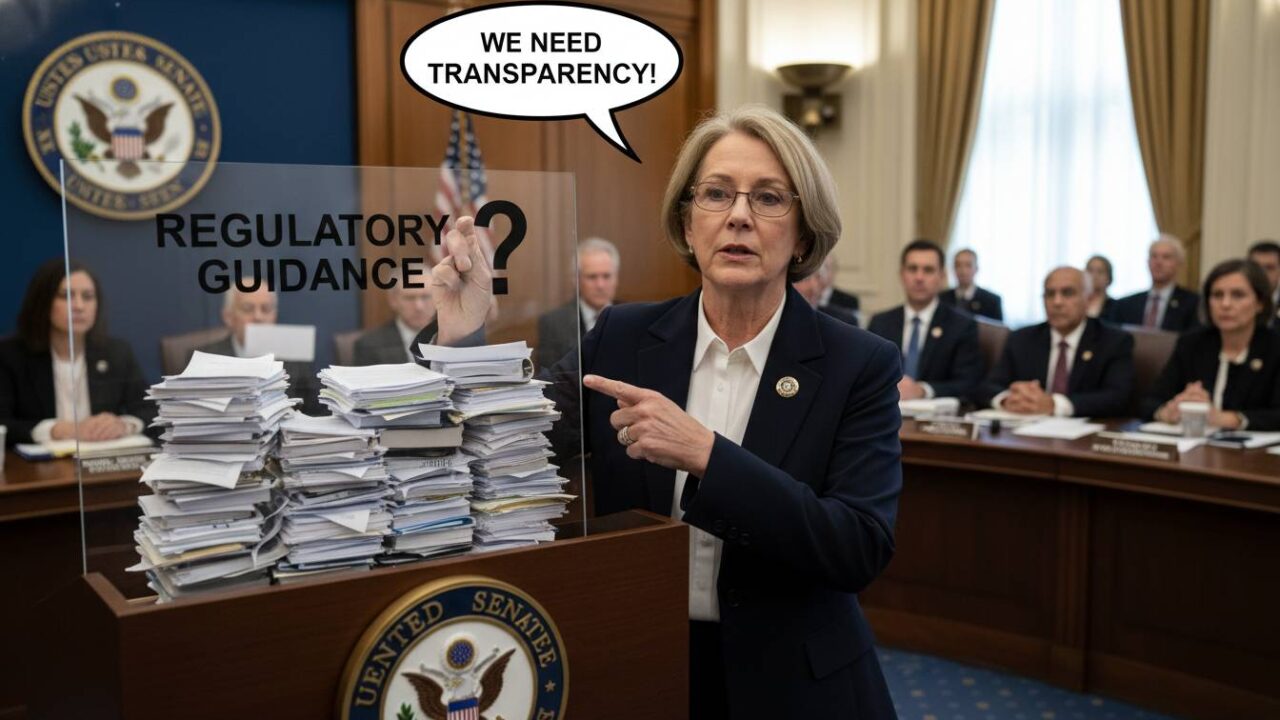
Senator Cynthia Lummis presented the CLARITY Act to the U.S. Senate on May 28, 2026, positioning the bill as a direct response to persistent regulatory uncertainty facing the U.S. crypto industry.cryptotimes.io. The legislation targets the $2.2 trillion global digital asset market by aiming to establish unified federal guidance, streamline oversight between agencies, and reduce contradictory mandates that have stifled innovation. Amid mounting competition from abroad—especially China’s digital yuan—Lummis contends that the U.S. must create apparent rules to avoid losing financial and technological leadership. The CLARITY Act now stands as a focal point for industry debate and Congressional action, setting expectations for investors and companies through late 2026.
How will the CLARITY Act change U.S. crypto rules
The CLARITY Act proposes a comprehensive structure, dividing regulatory responsibility by asset type: non-securities would be overseen by the Commodity Futures Trading Commission (CFTC). Tokenized securities would fall under the Securities and Exchange Commission (SEC), according to Crypto.news.
The bill directs exchanges, custodians, and wallet providers to follow standardized compliance set by international best practices. Cryptotimes.io reports that the requirements align with those already used in primary G20 economies, establishing unified reporting to the CFTC and other agencies. Of note, the Act introduces tailored exemptions for software developers and network validators who do not hold client funds or trade assets—protecting open-source cooperation and decentralized finance innovators.
$2.2T — Global Crypto Market Size (2026).
Federally licensed banks would be able to issue fully dollar-backed stablecoins, providing they meet strict capital requirements. Crypto.these banks must undergo quarterly federal audits and provide real-time disclosure of reserves, designed to prevent another “stablecoin flight” like the one in 2025. Regulators hope this will help U.S. institutions safely launch or distribute digital dollars, matching robust frameworks in the EU and Singapore by late 2025, according to cryptotimes.io.
Joint Congressional briefings from the SEC, CFTC, and Treasury will now be required annually. Agencies will need to publicly report enforcement actions and outcomes, and department heads must testify on regulatory moves to avoid the unilateral decisions that hurt markets in 2025.
Why is Lummis pushing for urgency now
China’s expansion of its digital yuan, which added millions of users in April 2026, raised pressure on U.S. lawmakers to accelerate Crypto lawmaking, according to Cryptotimes.io. Senator Lummis uses China’s brisk progress as evidence that delays will result in the U.S. ceding ground to rivals. Crypto.without plain federal rules, both startups and Wall Street firms are missing opportunities to launch tokenized financial products in the world’s largest market.
crypto companies have exceeded $6.7 billion, based on crypto.news. Many firms responded by cutting domestic hiring or moving headquarters overseas. Lummis refers to these figures as proof of a scaling “brain drain,” with mid-size startups hit hardest by unclear compliance burdens. In the last 18 months, at least ten U.S.-founded crypto unicorns shifted their primary business operations to countries such as Singapore, Switzerland, and the UAE to escape U.S. ambiguity. The goal is a committee vote before July—delaying further could see the Act stall until after the next Congressional cycle.
dropped 27% in Q1 2026, while Singapore’s deal volume jumped 44% as new licenses attracted asset managers globally. U.S. blockchain investments worth $1.9 billion remain frozen as of May 2026 due to persistent legal uncertainty. The CLARITY Act thus becomes not just a regulatory or financial issue, but also a test of national security and long-term competitiveness.
Conclusion
Removal of legal uncertainty is the center of the CLARITY Act, ending a core obstacle highlighted since early 2025, according to Crypto.news. Industry advocates see the law as a way for the U.S. to match the explicit crypto rules of Europe’s MiCA framework, potentially reviving America’s credibility with founders and investors. innovations in digital IDs, tokenized real-world assets, and programmable dollar-based products. Cryptotimes.io points to Congressional budget forecasts showing $2.4 billion in extra federal revenue each year, tied to improved digital asset tax compliance and new Treasury auctions for tokenized bonds.
Big week for digital assets. After nearly a year of bipartisan work, this markup brings us one step closer to cementing America’s place as the global leader in financial innovation.
— Senator Cynthia Lummis (@SenLummis) May 12, 2026
Wyoming showed the way, now Washington is following. https://t.co/dnwt8yT8it
Industry groups and financial trade lobbies voice strong support for Lummis’s proposal. Some of America’s top banks and fintech firms argue the Act could finally allow large incumbents to scale up blockchain adoption. Implementation will carry unpredictable variables, but the need for a stable roadmap enjoys wide backing. The next big moment arrives in the June 2026 committee sessions. The stakes are obvious for both Wall Street and Silicon Valley.
Crypto.out that the CLARITY Act’s detailed stablecoin guidance seeks to defend U.S. dollar leadership in digital settlements—a space now pressured by China’s digital yuan and the new euro-backed EUROe. As of Q1 2026, dollar-pegged stablecoins powered 61% of decentralized exchange settlements, per Cryptotimes.io, reinforcing the broad reach of U.S.-linked digital money.
Dollar-backed Stablecoins in DEX Settlement Q1 2026.
Now, legal frameworks—especially for stablecoins—shape which units dominate smart contracts and digital trades. The CLARITY Act aims to give as much legal certainty to digital assets as the U.S.
Transparent policy is now a bigger incentive than pricing for global capital. Crypto.in 2025, over $76 billion in U.S. crypto funds shifted to “pro-crypto” nations such as Switzerland, Singapore, and the UAE. In the same year, twelve new digital asset licenses were granted by these countries to firms leaving U.S. regulation behind. This trend redefines the competition between financial hubs. Lawmakers pushing for the CLARITY Act view the reversal of capital flight as both a fiscal and reputational win.
Between 2025 and 2026, six of the ten largest crypto exchanges are expected to restrict their services for U.S. customers because of regulatory obstacles, affecting choices for more than 8.5 million Americans. U.S.-based users now face fewer assets and higher fees due to the domestic patchwork. If the CLARITY Act passes, it could pave the way for cross-border licensing or “passporting,” letting U.S.
Lummis ties the bill to US’s foundation of finance
Senator Lummis pairs the CLARITY Act with the legacy of fundamental U.S.
At every legislative turn, Lummis frames the CLARITY Act as a present-day heir to the most important U.S. banking and securities reforms. io notes that the nation’s attention now focuses on whether Congress can deliver, as Lummis describes, “the definitive American answer” for global digital assets.
For more in-depth coverage or to share perspective on the CLARITY Act’s progress, visit Senator Lummis Pushes CLARITY. With Congressional hearings and evolving market reactions expected through Q3 2026, the Act’s fate will influence models worldwide. Decisions this year will decide whether the U.S. stays central to digital markets or continues to lose ground to nimble rivals.
This article is for informational purposes only. Always verify information independently before making any decisions.

About the author
Marcus Webb
Chief Macro Economist
Chief Macro Economist covering Federal Reserve policy, treasury markets, and global macroeconomic trends.
More about Marcus Webb → Hide details ↑
Chief Macro Economist covering Federal Reserve policy, treasury markets, and global macroeconomic trends. Former Federal Reserve researcher and economist at Goldman Sachs Global Investment Research. PhD in Economics from MIT. Fifteen years of experience analyzing monetary policy impacts on financial markets.
- Beat:
- Federal Reserve · Interest rates · Treasury markets · Global macro · Currency policy
- Education:
- MIT · PhD Economics
- Certifications:
- PhD, CMT
- Memberships:
- American Economic Association · NABE
Editorial standards · Fact-checked against named sources. Reporters cannot trade securities they cover. Guidelines · Methodology · Report an error