
What Is an Algorithmic Stablecoin?
An algorithmic stablecoin uses code and supply rules, not full reserves, to hold its peg. Learn how they work and why they can collapse.
An algorithmic stablecoin is a token that tries to hold a steady value using programmed rules that expand or shrink its supply, rather than by holding full reserves of cash or collateral. When the price drifts above the peg, the protocol creates more tokens to push it down; when it drifts below, it tries to remove tokens from circulation to push it back up.
These designs are the most experimental category of stablecoin, and they have a track record that includes some high-profile failures. Understanding why they can collapse is essential before treating any of them as truly “stable.” For the broader category and how it compares, see what is a stablecoin.
How algorithmic stablecoins differ from collateralized ones
A fiat-collateralized stablecoin holds reserves so that, in principle, each token can be redeemed for a dollar. A crypto-collateralized stablecoin locks up overcollateralized crypto in smart contracts. An algorithmic stablecoin, by contrast, may hold little or no hard collateral and instead relies on market incentives and code to keep the price near its target.
The appeal is capital efficiency and decentralization: there is no central issuer holding a bank account, and less capital sits idle as collateral. The weakness is that the peg depends heavily on continued demand and confidence. When those fade, the same mechanism that defends the peg in good times can work violently in reverse.
How the supply mechanism works
Most algorithmic designs adjust supply automatically based on the market price:
- Above the peg: The protocol mints new tokens, increasing supply to bring the price back down toward the target.
- Below the peg: The protocol tries to reduce supply, often by incentivizing users to burn the stablecoin in exchange for another asset the system controls.
The burning step is where many designs become fragile, because it usually relies on a second token whose value is itself tied to belief in the system. When that belief is strong, the mechanism looks elegant. When belief weakens, the same mechanism can accelerate a collapse rather than prevent it.
What is a seigniorage or two-token model?
A common approach uses two tokens: the stablecoin itself and a companion “absorber” or governance token. When the stablecoin falls below its peg, users are encouraged to swap it for newly issued companion tokens, which reduces the stablecoin’s supply and is meant to lift its price. This works as long as the companion token holds meaningful value, but it can break down badly under stress, as the next section explains.
Why algorithmic stablecoins can enter a death spiral
The most serious risk is a self-reinforcing collapse, sometimes called a death spiral. It tends to unfold in a predictable sequence:
- Confidence drops and the stablecoin falls below its peg.
- The mechanism mints large amounts of the companion token to try to defend the peg.
- That flood of new companion tokens crashes the companion token’s own price.
- With the companion token now nearly worthless, there is nothing credible left to absorb the selling pressure.
- Both tokens can spiral toward zero as holders rush for the exit at the same time.
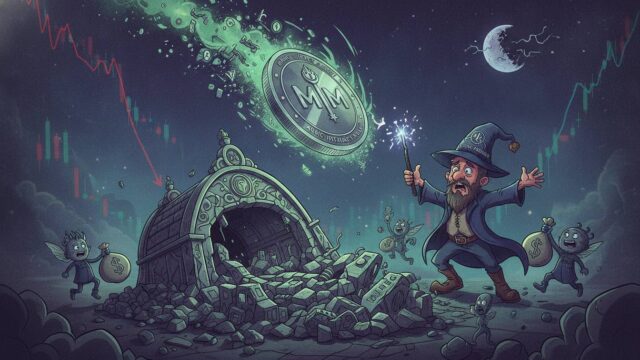
The 2022 collapse of the TerraUSD (UST) system is the most cited real-world example of this dynamic, in which a large algorithmic stablecoin and its companion token both lost the vast majority of their value in a short period. This is a documented historical event, not a price prediction, and it illustrates how quickly confidence-based pegs can unravel once a run begins. Understanding what makes crypto go up and down helps explain why panic accelerates these failures so rapidly.
Comparing algorithmic and collateralized stablecoins
| Factor | Algorithmic | Collateralized |
|---|---|---|
| Backing | Supply rules, little or no hard collateral | Cash reserves or overcollateralized crypto |
| Peg defense | Minting and burning incentives | Redemption or liquidation |
| Main failure mode | Confidence-driven death spiral | Reserve doubts or collateral crash |
| Track record | Includes major collapses | Generally more resilient |
Hybrid and partially collateralized designs
Some projects blend approaches, using partial collateral alongside algorithmic supply adjustments. These aim to capture some capital efficiency while keeping a buffer against panic, so that even if confidence wobbles there is real value backing part of the supply. Even so, any design that leans on algorithmic mechanisms and market confidence carries elevated risk compared with a fully collateralized model, especially during sharp, fast market downturns when the buffer may prove too small.
Where you might encounter them
Algorithmic and hybrid stablecoins often appear inside DeFi protocols, where their capital efficiency is attractive for building lending markets and trading pairs. That means the risk is not always obvious: a stablecoin embedded in a yield strategy or liquidity pool can quietly carry algorithmic peg risk. Before using any stablecoin as if it were cash, it is worth checking how it actually maintains its peg rather than assuming all dollar-pegged tokens are equally safe.
How to evaluate the risk
When examining any stablecoin that claims to be algorithmic or partially algorithmic, useful questions include: How much real collateral is there, if any? What is designed to happen to the peg mechanism during a sudden loss of confidence? Is the companion token’s value circular, meaning it depends on the very system it is supposed to support? These are the kinds of questions covered in crypto fundamental analysis. It is also worth being skeptical of any explanation that cannot clearly answer what happens when many holders try to exit at once, since that is precisely the moment a fragile peg is tested and the moment when a clear, credible mechanism matters most.
This is educational content, not financial advice, and it does not endorse any specific stablecoin. Algorithmic stablecoins remain experimental, and history shows they can fail suddenly and completely, so caution is warranted.
Warning signs and lessons from past failures
Past collapses share recognizable patterns, and knowing them helps you spot elevated risk before committing funds. A few recurring warning signs stand out:
- Circular value: The peg is defended using a companion token whose own value depends on confidence in the stablecoin, creating a loop with no independent anchor.
- Unusually high yields: Very high advertised returns for simply holding or staking the stablecoin can attract deposits that vanish the moment confidence wavers, since the yield often depends on continued inflows rather than real revenue.
- Thin real collateral: Little or no hard backing means there is nothing to redeem against when demand collapses.
- Reliance on constant growth: Designs that only stay stable while the system keeps expanding are vulnerable the instant growth stalls.
The broader lesson is that a peg is only as strong as what backs it under stress, not what backs it on a calm day. Marketing language such as “stable” or “fully decentralized” is not a substitute for a mechanism that can absorb a sudden rush of sellers. When these warning signs appear together, the risk of a rapid, permanent loss rises sharply, which is why many people treat purely algorithmic stablecoins as speculative instruments rather than as reliable stores of value.
Frequently asked questions
How is an algorithmic stablecoin different from a normal one?
An algorithmic stablecoin uses programmed supply rules to defend its peg, often with little or no hard collateral. Collateralized stablecoins instead hold cash reserves or overcollateralized crypto that can back or redeem the tokens.
What is a stablecoin death spiral?
A death spiral is a self-reinforcing collapse where a falling stablecoin triggers heavy minting of a companion token, which crashes that token’s value, removes the peg’s support, and drives both assets toward zero as holders flee.
Did an algorithmic stablecoin ever collapse?
Yes. The 2022 failure of the TerraUSD system is the most cited example, in which a large algorithmic stablecoin and its companion token both lost most of their value very quickly. It is a well-documented historical event.
Are all algorithmic stablecoins uncollateralized?
Not entirely. Some are fully algorithmic, while hybrid designs hold partial collateral alongside supply-adjustment mechanisms. Any reliance on algorithmic peg defense and market confidence, however, tends to increase risk under stress.
Why would anyone use an algorithmic stablecoin?
The appeal is capital efficiency and decentralization, since these designs avoid locking up full reserves or relying on a central issuer. The trade-off is a peg that depends heavily on continued demand and confidence to hold.
Are algorithmic stablecoins safe?
They are the most experimental and historically the most fragile stablecoin type, with documented total collapses. This article is educational, not financial advice, so treat any peg that relies mainly on algorithms with strong caution.

About the author
Marcus Webb
Chief Macro Economist
Chief Macro Economist covering Federal Reserve policy, treasury markets, and global macroeconomic trends.
More about Marcus Webb → Hide details ↑
Chief Macro Economist covering Federal Reserve policy, treasury markets, and global macroeconomic trends. Former Federal Reserve researcher and economist at Goldman Sachs Global Investment Research. PhD in Economics from MIT. Fifteen years of experience analyzing monetary policy impacts on financial markets.
- Beat:
- Federal Reserve · Interest rates · Treasury markets · Global macro · Currency policy
- Education:
- MIT · PhD Economics
- Certifications:
- PhD, CMT
- Memberships:
- American Economic Association · NABE
Editorial standards · Fact-checked against named sources. Reporters cannot trade securities they cover. Guidelines · Methodology · Report an error